
Training is the invisible backbone of site safety. We assume that if a worker holds a card, they have the competence to protect themselves and their colleagues. But as the Metropolitan Police’s Operation Resolute recently proved, assuming competence without rigour is a dangerous gamble.
On 31 March 2026, three men were sentenced at Snaresbrook Crown Court for a year-long fraud operation. They charged vulnerable candidates up to £850 to bypass Health and Safety exams using Bluetooth earpieces.
This construction training malpractice resulted in over 70 workers being sent onto sites with fake credentials.

The Fallout
In 2026, the “Failure to Prevent Fraud” offence means that organisations are now under a strict liability. If a subcontractor on your site is found to have cheated their way into a qualification, your “reasonable procedures” defense will be interrogated.
This presents a serious risk for contractors. Beyond the legal liability, there is the immediate danger of having workers on-site who lack a foundational understanding of health and safety – whether due to language barriers or a deliberate bypass of the system. When the assessment process fails, these risks remain hidden until an incident occurs.
Active Security: Solving Construction Training Malpractice
At TrustTest by COSAC, we believe that “Pass” must be a verified statement of fact. We move away from the honour system and toward a human-led methodology that secures the entire assessment journey.
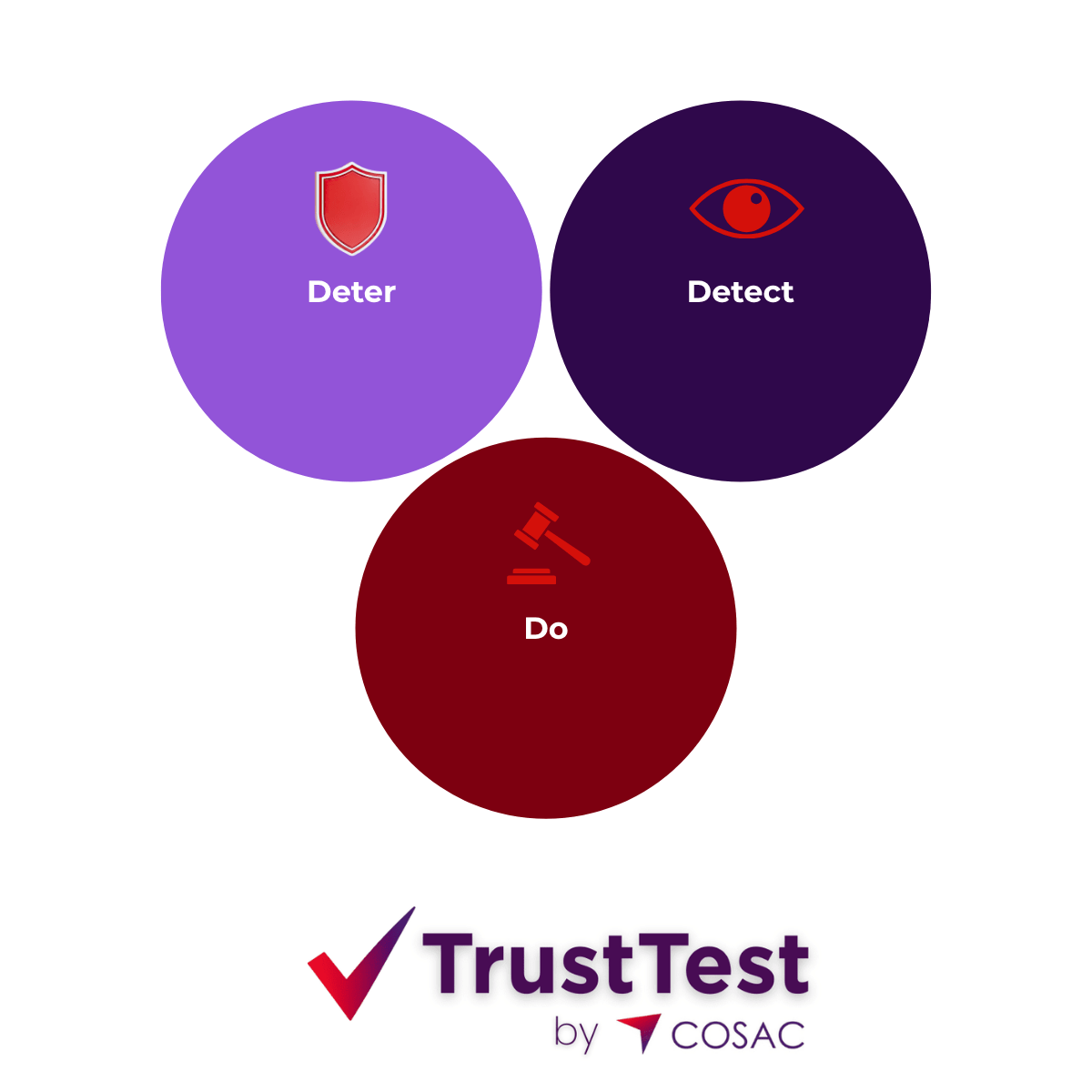
For eAssessment providers, staying ahead of malpractice is not a static task. It requires a willingness to constantly amend platforms and processes to ensure the following cycle remains robust:
1. DETER: Stopping Malpractice Before it Starts
Fraudsters thrive on weak entry points. TrustTest uses rigorous, human-verified identity checks and environment scans. By making it technically and physically difficult to introduce external tech (like Bluetooth earpieces) from the start, we remove the easy win for organised crime.
2. DETECT: Human-Led Monitoring and Context
Automation often misses the subtle cues of cheating. A bot might not see a tiny earpiece, but a trained human invigilator can identify suspicious listening behaviour and anomalous responses in real-time. Our People, Platform, and Process approach ensures that detection is context-aware and immediate.
By focusing on a user-centred approach, we ensure that while the process is rigorous, it remains accessible to legitimate candidates while exposing those attempting to bypass the system.
3. DO: The Defensible Audit Trail
The CITB is currently in the arduous process of revoking cards months after the fact. With TrustTest, the record-keeping is proactive. We provide a time-stamped, human-verified audit trail that stands up to regulatory scrutiny. If an incident occurs, you aren’t searching for a paper trail; you have the evidence ready.

Conclusion: Competence Cannot Be Assumed
The Met Police investigation proves that fraudsters are becoming more sophisticated. This reality places a new burden on eAssessment providers to be proactive. We cannot be afraid to evolve our technology and our invigilation standards to meet these emerging threats.
Rigour isn’t about making exams harder; it’s about making them honest. In an industry where a single mistake can be fatal, being in the room is no longer enough. It’s time to move toward evidence-based competence.